La science de se sentir cool
Le problème
Lorsqu'il est exposé à la chaleur, le corps commence à se thermoréguler en essayant de ramener la température centrale à l'équilibre.
Nous le faisons en augmentant le flux sanguin vers la peau et la production de sueur.
Lors d'un travail physique, plutôt que d'avoir le flux sanguin vers la peau pour dégager un excès de chaleur, il est dirigé vers les muscles car ils ont besoin d'un niveau accru d'oxygène. Sans cela, le corps accumulera de l'acide lactique, provoquant une sensation de brûlure douloureuse. La diminution du flux sanguin vers la peau qui en résulte conduira finalement le corps à stocker plus de chaleur.
Sans la capacité de se refroidir, le corps continuera à stocker de la chaleur, augmentant ainsi la température interne. L'effet le plus reconnu est la perte de concentration et l'incapacité à se concentrer sur une tâche.
Le rapport CR-1205 (1) sur le stress thermique de la NASA a révélé que les températures supérieures à 80 °F ont un effet NÉGATIF marqué à la fois sur la productivité et la précision du travail . À 95 ° F, le rapport a montré que les participants à l'étude faisaient 60 erreurs / heure. C'est 1 erreur chaque minute.
How heat affects performance
| Effective temperature | Loss in output | Loss in accuracy |
|---|---|---|
| 23.9° C | 3% | Negligible |
| 26.6° C | 8% | 5% |
| 29.4° C | 18% | 40% |
| 32.2° C | 29% | 300% |
| 35° C | 45% | 700% |
| 37.7° C | 62% | >> |
| 40.5° C | 79% | ->> |
The ActiCool solution
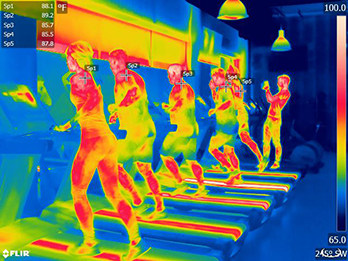
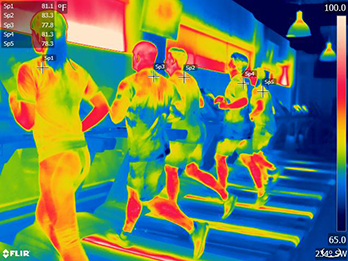
Thermal imaging
When we designed ActiCool, we spent a lot time in R&D working with multiple labs to make sure that what we were building was going to work.
We started off with thermal imaging, seeing exactly how the fabrics cool the surface temperature of the skin in various environments and at different levels of strenuous activities. We also performed testing on our users, taking their temperature and heart rate, and monitoring their required amount of hydration.
QMax testing
Then we got really scientific.
We turned to QMax testing, a method of testing the instantaneous feeling of warmth or coolness of an object that encounters the skin.
Basically, how our ActiCool fabrics feel against the skin on contact. The higher the value, the cooler the item feels.
How ActiCool feels against the skin (W/cm2)
Thermal effusivity
Then we moved on to thermal effusivity testing. Thermal effusivity is most typically measured to predict how cool or warm a textile feels.
It has a square root proportionality to the density, thermal conductivity, and specific heat capacity of the material. Dry fabrics often contain pockets of air between the strands, resulting in thermal effusivity values that are typically low. When dry fabrics are exposed to moisture, the air is replaced by water, which has a much higher thermal effusivity. This will cause the fabric to exhibit a higher thermal effusivity value when wet, making it feel cooler.
That is the reason why we moved over to thermal effusivity testing, as it is based on the fact that we are always sweating, and that ActiCool begins to absorb the moisture and humidity from your skin on contact. As we move around and heat up, we sweat more, so we tested our gear at all levels of anticipated physical output.
Effusivity vs moisture
- ActiCool
- Athletic wear
- Expected working range